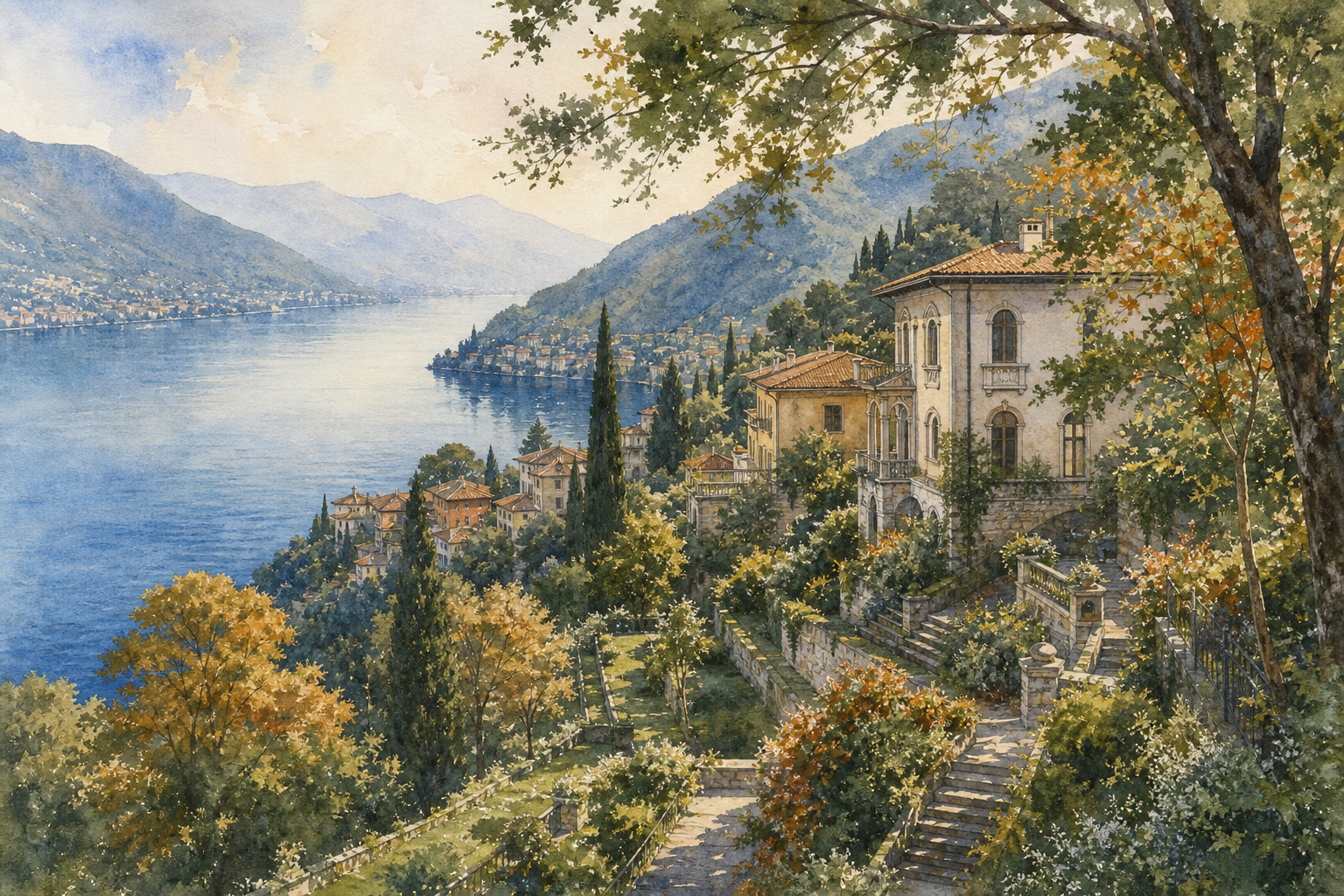
Both lakes are real, both are beautiful, and both will disappoint you if you pick the wrong one for your travel style. Lake Como and Lake Garda sit in the same region of Northern Italy, yet they feel like entirely different countries. This guide walks you through the five decisions that actually matter, so you arrive at the right one.
Table of Contents
- Step 1: Understand What Each Lake Actually Offers
- Step 2: Match the Lake to Your Travel Style
- Step 3: Consider Where You Will Stay
- Step 4: Compare Accessibility and Logistics
- Step 5: Weigh the Key Differences Side by Side
- FAQ
- Conclusion
Step 1: Understand What Each Lake Actually Offers
Start here, before you look at a single hotel. The two lakes have different personalities, different scales, and different relationships with the surrounding landscape. Getting that straight first saves a lot of backtracking.
Lake Como is Italy's deepest lake, shaped like an upside-down Y, with steep mountains falling almost directly to the water. The towns along its shores are small. Some, like Varenna and Bellagio, can be explored in an afternoon. Others, like Lenno and Tremezzo, are barely more than a jetty and a row of restaurants. The landscape is dramatic and compact. Grand villas with terraced gardens line the banks: Villa del Balbianello in Lenno, Villa Carlota in Tremezzo with its botanical gardens, Villa Monastero in Varenna. The pace is unhurried. The food leans Swiss-Italian, heavier and creamier than you might expect from a summer destination this close to Milan.
Lake Garda is Italy's largest lake, more than twice the size of Como. That scale means genuine variety. The northern shore is Alpine and rugged, popular with windsurfers and hikers. The southern end opens into gentle rolling hills, vineyards, and lemon groves. The microclimate around Garda is mild enough to grow citrus, which is unusual this far north. Towns like Sirmione sit on a narrow peninsula surrounded by Roman ruins and thermal springs. Garda has more of a family-holiday feel. Local Italians love it. It is less celebrity-watched than Como, more workaday, and often more relaxed to handle.
The food culture at Garda leans into the lake itself. Bigoli con le sarde, a traditional egg pasta made with fresh sardines, is a regional staple. Olive oil from the western shore is serious enough to carry its own designation. The local wine, particularly Bardolino and Lugana from the southern shores, is worth seeking out.
Key Takeaway: Como rewards stillness and villa culture; Garda rewards variety, outdoor activity, and a longer stay with more ground to cover.
Step 2: Match the Lake to Your Travel Style
Once you know what each lake is, the question becomes which one fits the trip you are actually planning. Travel style matters more than any ranking.
If you want quiet, walking, and the feeling of being in a historic house rather than a resort, Lake Como is the better fit. The villages are small enough to feel personal. The funicular from Como town up to the hillside village of Brunate has been running since 1894, and the ridge paths above Brunate connect directly to longer trails on the Via dei Monti Lariani. This is not a destination for crowds or beach clubs. It is a destination for people who want to slow down.
If you are travelling with children, or you want water sports, Garda is the clearer choice. The northern stretch around Malcesine is one of Europe's best windsurfing spots, with schools operating daily through summer. Waterski, wakeboard, and kitesurfing operators work out of multiple towns along the shore. The lake is wide enough that the water stays organised even on busy weekends. Families with young children tend to find Garda more forgiving, with flatter towns, sandy beaches, and more affordable restaurants.
For cyclists, both lakes have something serious to offer. Garda has a narrow road carved into the cliffs above the western shore, which is a genuine climbing route. Como has the Brunate hillclimb: six kilometres from the lakefront, 500 metres of elevation gain, and a quiet village at the top. Riders who want a fixed base and a hard morning climb tend to favour the Como side. Groups exploring longer loops around the Triangolo Lariano find Brunate well-positioned as a starting point.
For a wedding or a private celebration, the question shifts again. Garda has beautiful properties, but Como has the villa heritage and the hillside settings that guests tend to remember. Corporate groups planning off-site retreats often prefer Como for the same reason: the setting feels considered rather than resort-like, and the proximity to Milan Malpensa, one hour away, keeps logistics simple.
Pro Tip: If your group has mixed interests, give Garda the edge for stays longer than four nights. For shorter, more focused trips centred on atmosphere, Como wins on density of experience per day.
Step 3: Consider Where You Will Stay
Accommodation shapes the whole trip. Where you sleep at either lake determines how much you walk, how easily you get on the water, and whether the base itself becomes part of the experience.
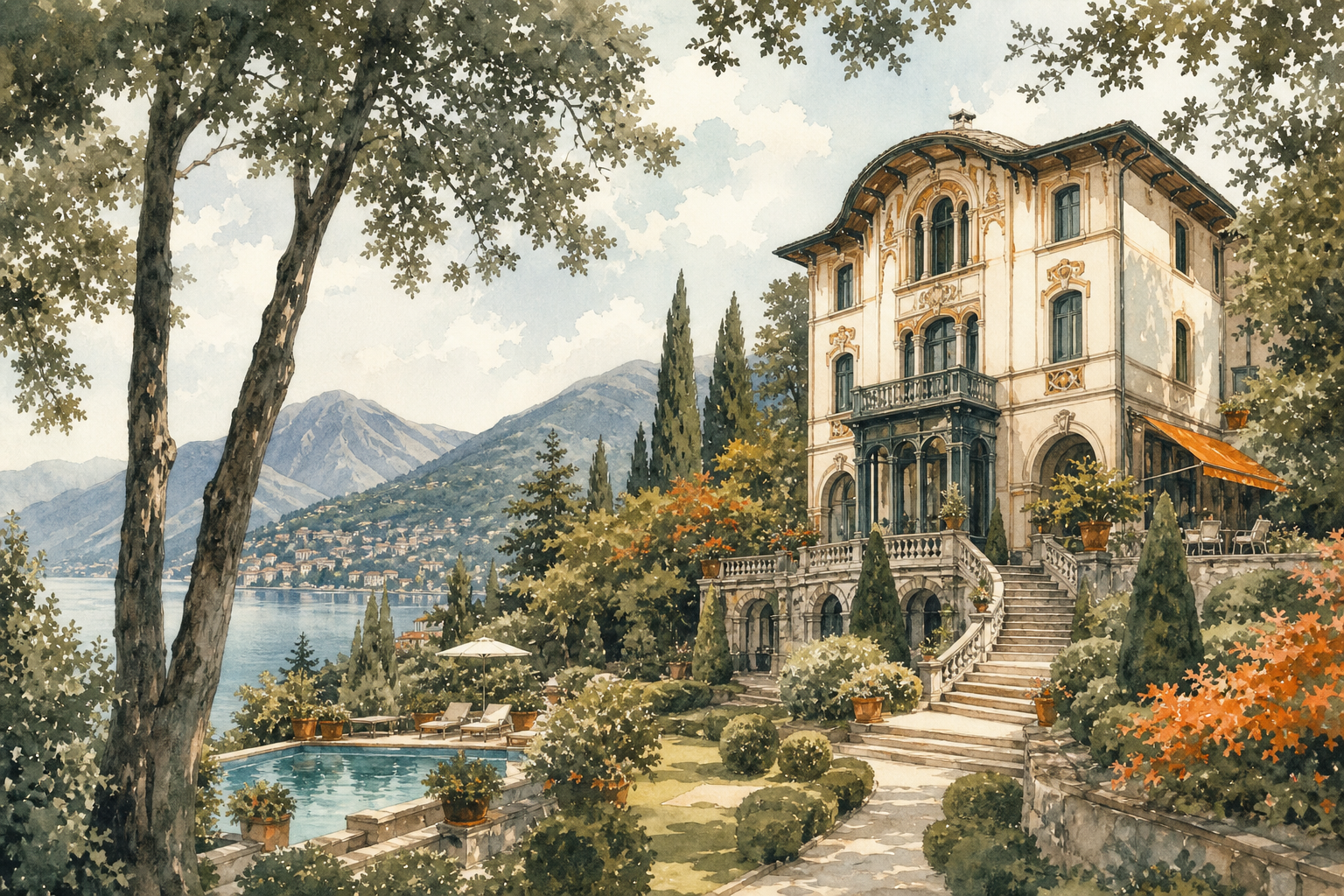
On the Como side, Villino Rubini sits in Brunate, the hillside village above Como town. The estate dates to 1892 and was built in the Art Nouveau style, with original ceiling mouldings, period floors, and interior details that were preserved rather than replaced during a recent restoration. Ten rooms across three buildings, the Villa, the Dependance, and the Orangerie, accommodate up to nineteen guests. The grounds run to four acres of beech forest and formal gardens, with a heated pool, spa, sauna, gym, and studio within the private grounds. Continental breakfast and daily housekeeping are included. A private shuttle connects guests to the Como-Brunate funicular. For groups wanting the whole estate, exclusive hire is available, and the gardens can seat up to one hundred guests outdoors under a tent for dinner or celebrations.
This is not a hotel. It is a private estate run by people, for guests who prefer homes to hotels. That distinction matters when you are choosing between two lakes and weighing what the base should feel like. Villino Rubini sits above the lake rather than on it, set in the hills with no road noise and genuine quiet. Milan Malpensa is one hour away, Como town ten minutes below by funicular or car.
On the Garda side, options range from boutique hotels to large historic properties. Grand Hotel a Villa Feltrinelli in Gargnano is one of the most cited properties on the western shore, a pale pink palazzo that operates as a hotel rather than a private estate and carries two Michelin stars in its restaurant. Villa Remo, also on Garda, has twelve rooms with an infinity sky pool and spa. Natiaa offers a more theatrical arrival, with guests reaching the property by carriage along a chestnut-lined path, and includes a steam bath and historic castle on site.
For those booking individual rooms rather than whole-property hire, both lakes have boutique hotel options at a wide range of price points. Boutique Hotel Villa Sostaga and Villa Arcadio on Garda both appear regularly in quality shortlists. On Como, Villa Carlota in Tremezzo is a well-known address, recognised for its botanical gardens.
One pattern worth noting: many high-end estates on both lakes do not publish room counts or capacities. Of the private villa-style properties researched across both lakes, fewer than a quarter disclosed how many guests they can actually accommodate. That opacity complicates planning for larger groups. Villino Rubini's published capacity of nineteen guests and outdoor dinner capacity of one hundred is unusually transparent, and useful when coordinating with caterers, transport operators, or event planners.
Step 4: Compare Accessibility and Logistics
Getting there and moving around can make or break a lake holiday, especially if the group is arriving from different directions or needs day trips to nearby cities.
Lake Como sits closer to Milan. The train from Milan's central station reaches Como San Giovanni in roughly 40 minutes on a fast service. Milan Malpensa airport is about an hour by road. That makes Como genuinely easy to reach for international travellers on a direct transatlantic or European flight. The lake itself is best explored by ferry. The public boat service connects most towns, and a ferry pass for a day or two covers most of what visitors want to see. Cars are possible but not necessary, and parking in the more popular towns is tight in summer.
Lake Garda is served by two rail stations, Desenzano del Garda and Peschiera del Garda, both on the southern shore. Verona airport is roughly 30 minutes away, and Milan Bergamo is about 50 minutes. The catch is that the train stations are in the south, so anyone heading to the northern or western shore needs a bus, taxi, or hired car for onward travel. A hire car is widely considered the most practical way to explore Garda properly, which is an honest assessment. The lake is large enough that public transport alone leaves the northern reaches harder to access. For groups with luggage or families with children, a private transfer or rental car is worth the cost.
Day trips from Como to Milan are easy and common. From Garda, Verona is the natural day trip, about 30 minutes by train from the southern shore. Garda also sits closer to the Dolomites for anyone building a multi-stop itinerary. Como is better placed for Switzerland, with cross-border rail connections available from the region for those who want a cross-border excursion.
For corporate groups flying in from London, New York, or other long-haul origins, Como's proximity to Malpensa is a real logistical advantage. The estate at Brunate can be reached directly from the airport in under an hour, with no complicated transfers.
Step 5: Weigh the Key Differences Side by Side
With the detail covered, here is a direct comparison of the two lakes across the decisions that tend to matter most. Use this as a final check before committing.
| Factor | Lake Como | Lake Garda |
|---|---|---|
| Scale and variety | Compact, dramatic, steep | Large, diverse north-to-south |
| Best travel style | Quiet, cultural, walking-focused | Active, family-friendly, water sports |
| Private estate stays | Strong villa heritage; Villino Rubini in Brunate offers exclusive hire for up to 19 guests | Good hotel options; Villa Remo and Grand Hotel a Villa Feltrinelli are well-regarded |
| Getting there | 40 min from Milan by train; 1 hr from Malpensa | 30 min from Verona airport; car useful |
| Day trips | Milan, Switzerland, and cross-border rail connections | Verona, Dolomites |
| Food character | Swiss-Italian, richer cuisine | Lake fish, olive oil, local wine |
| Weddings and events | Historic villa settings with garden capacity | Hotel-based event spaces more common |
| Cycling and hiking | Brunate hillclimb, Via dei Monti Lariani | Narrow cliff roads and northern Alpine trails |
If you are planning a wedding, a private group stay, or a corporate retreat where the setting itself matters, Como's villa culture gives it a clear edge. The Lake Como wedding venue at Villino Rubini is one of the few estates on the lake with published capacity and full exclusive hire available, which matters when you are coordinating logistics across a group. Groups of any kind benefit from having the numbers confirmed before they commit. For active holidays with water sports, a large family, or a first trip to Northern Italy where maximum variety helps, Garda is the more forgiving choice.
Neither lake is wrong. But most people, once they answer the questions in Steps 1 through 4 honestly, find they already knew which one they wanted.
FAQ
Which lake is better for a romantic trip, Lake Como or Lake Garda?
Lake Como tends to suit romantic stays better. The scale is intimate, the villages are quieter, and the private estate options, including Villino Rubini in Brunate, give couples a sense of genuine seclusion. Garda is livelier and more family-oriented, which suits some couples but feels busier for those looking for stillness. If the two of you want a working pool, quiet mornings, and a historic setting, Como is the stronger choice.
Is Lake Garda bigger than Lake Como?
Yes. Lake Garda is Italy's largest lake and is more than twice the surface area of Lake Como. That size gives Garda more variation in landscape, climate, and town character from north to south. Como is smaller and more uniform in feel, which makes it easier to experience fully in a shorter visit.
How many days do you need for each lake?
Four to five days works well for Lake Como. The main villages are compact and close together, so a day by ferry covers a lot. Lake Garda benefits from a longer stay, five to seven days, because the distance between the northern and southern shores means you need time to reach the best parts. A hire car speeds things up considerably on Garda.
Can you stay above Lake Como rather than on the waterfront?
Yes, and for some guests it is the better option. Brunate, the hillside village above Como town, has the Art Nouveau estate of Villino Rubini with ten rooms and four acres of private grounds. The funicular, running since 1894, connects it to the lakefront in minutes. The village is quieter than any waterfront town, with hiking trails starting from the door and no road noise.
Which lake is easier to reach from Milan?
Lake Como is easier from Milan. The train from Milan Centrale to Como San Giovanni takes about 40 minutes on a fast service, and Milan Malpensa airport is roughly an hour by road. Lake Garda is served by Verona airport, about 30 minutes away, and Milan Bergamo, about 50 minutes. For international travellers arriving into Malpensa, Como has the more direct connection.
Which lake is better for a corporate retreat?
Lake Como is generally better for corporate retreats that need a private, contained setting. Private estate hire, like the exclusive use option at Villino Rubini, keeps a group together in one house with dedicated grounds, a gym, spa, and studio on site. The proximity to Milan also makes logistics simpler for teams flying in from multiple cities. Garda works well for retreats that prioritise outdoor activity over contained group space.
Conclusion
The choice between the two lakes comes down to a single question: do you want variety and activity, or atmosphere and quiet? For most people reading this, the answer reveals itself somewhere in Step 2. If you are leaning toward Lake Como and want a private base above the lake with real estate character, take a closer look at Relais Villino Rubini in Brunate. The estate accommodates individual guests on a bed-and-breakfast basis and takes exclusive hire for groups. Reaching out with your dates and group size is the simplest next step.
Occasional stories from the estate, sent a few times a year at most.